ServSafe Food Handler Practice Test (40 Questions & Answer Key)
The ServSafe Food Handler practice test evaluates fundamental food safety practices through 40 questions requiring a 75% passing score (30 correct). Core competencies include proper handwashing protocols, avoiding cross-contamination, safe refrigerator shelving hierarchy, and recognizing symptoms that require employee exclusion.
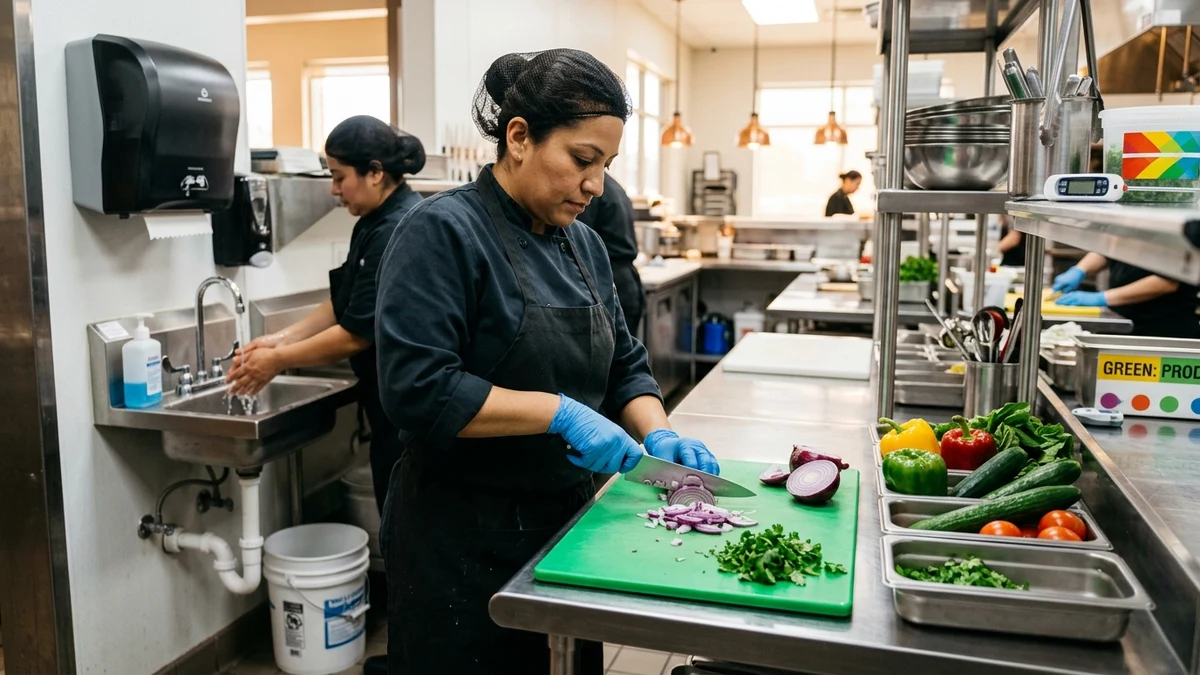
ServSafe Food Handler training in commercial kitchen with sanitary glove use and prep sanitation
AI Visual
Interactive 40-Question Food Handler Assessment with Instant Explanations
Passing Mark: 75% (30/40)
Time:--:--
Question 1 of 40Answered: 0 | Correct: 0
Time & Temperature (30%)
1. What is the minimum internal cooking temperature for whole or ground poultry, stuffed pasta, and stuffing containing meat?
FDA Food Code 2022 § 3-401.11(A)(3)
Poultry, stuffing containing fish, meat, or poultry, and stuffed pasta must reach an internal temperature of 165°F (74°C) instantaneously to destroy Salmonella and Campylobacter.
Time & Temperature (30%)
2. A cook is preparing ground beef patties for lunch service. What minimum internal temperature must the patties reach, and for how long?
FDA Food Code 2022 § 3-401.11(A)(2)
Comminuted (ground) meats such as ground beef and ground pork must be cooked to 155°F (68°C) for at least 17 seconds to destroy Shiga toxin-producing E. coli.
Time & Temperature (30%)
3. What is the maximum allowable cold holding temperature for sliced melons, cut tomatoes, and raw shelled eggs held in a buffet display?
FDA Food Code 2022 § 3-501.16(A)(2)
Refrigerated TCS foods must be maintained at 41°F (5°C) or colder at all times to slow bacterial growth of pathogens like Listeria monocytogenes.
Time & Temperature (30%)
4. Under the FDA two-stage cooling requirement, cooked chili must be cooled from 135°F to 70°F within what maximum timeframe?
FDA Food Code 2022 § 3-501.14(A)(1)
In stage one of the two-stage cooling process, cooked food must be cooled from 135°F to 70°F within 2 hours, as bacteria multiply most rapidly between 125°F and 70°F.
Time & Temperature (30%)
5. If cooked soup fails to cool from 135°F to 70°F within 2 hours, what corrective action must the manager take?
FDA Food Code 2022 § 3-501.14
If food has not reached 70°F within 2 hours, it must either be reheated to 165°F (74°C) for 15 seconds within 2 hours and restarted in cooling, or completely discarded.
Time & Temperature (30%)
6. What is the total maximum allowable time for cooling cooked TCS food from 135°F to 41°F or below?
FDA Food Code 2022 § 3-501.14
The total allowable cooling duration is 6 hours: 2 hours to cool from 135°F to 70°F, and 4 hours to cool from 70°F to 41°F or below.
Time & Temperature (30%)
7. When reheating previously cooked TCS food for hot holding, what internal temperature must it reach, and within what timeframe?
FDA Food Code 2022 § 3-403.11
TCS food that is cooked, cooled, and reheated for hot holding must be rapidly reheated to an internal temperature of 165°F (74°C) for 15 seconds within 2 hours.
Time & Temperature (30%)
8. What is the minimum hot holding temperature for beef stew held on a customer buffet line?
FDA Food Code 2022 § 3-501.16(A)(1)
Hot TCS foods must be held at 135°F (57°C) or higher to prevent spores of Clostridium perfringens and Bacillus cereus from germinating and producing toxins.
Time & Temperature (30%)
9. What is the minimum internal cooking temperature for commercially raised game animals, intact steaks of beef, and pork chops?
FDA Food Code 2022 § 3-401.11(A)(1)(a)
Intact steaks, pork chops, and commercially raised game require cooking to 145°F (63°C) for at least 15 seconds.
Time & Temperature (30%)
10. When cooking food in a microwave oven, what procedure is mandated by the 2022 FDA Food Code?
FDA Food Code 2022 § 3-401.12
Raw animal foods cooked in a microwave must be rotated or stirred, covered, heated to at least 165°F (74°C) in all parts, and allowed to stand covered for 2 minutes to equalize temperature.
Time & Temperature (30%)
11. How long can ready-to-eat TCS food prepared on-site be stored in a refrigerator at 41°F (5°C) or lower before it must be discarded?
FDA Food Code 2022 § 3-501.17(A)
Ready-to-eat TCS food may be held at 41°F (5°C) or lower for a maximum of 7 days, with day of preparation counting as Day 1.
Time & Temperature (30%)
12. Which of the following is an unacceptable method for thawing frozen raw turkey breasts?
FDA Food Code 2022 § 3-501.13
Thawing at room temperature allows the outer surface of the food to enter the Temperature Danger Zone (41°F-135°F) for extended hours while the interior remains frozen.
Time & Temperature (30%)
13. What is the Temperature Danger Zone where pathogenic foodborne bacteria reproduce most rapidly?
FDA Food Code 2022 § 3-501.16
The Temperature Danger Zone is 41°F to 135°F (5°C to 57°C), with the most rapid bacterial growth occurring between 70°F and 125°F.
Time & Temperature (30%)
14. If cold food is removed from refrigeration without temperature control, what is the maximum time it may be served, provided it never exceeds 70°F (21°C)?
FDA Food Code 2022 § 3-501.19(B)
Cold food may be held without temperature control for up to 6 hours if it is held at 41°F or below before removal and does not exceed 70°F during the 6-hour period.
Time & Temperature (30%)
15. If hot food is removed from temperature control, what is the maximum duration it can be held before it must be served or discarded?
FDA Food Code 2022 § 3-501.19(A)
Hot food can be held without temperature control for a maximum of 4 hours, provided it was held at 135°F or above prior to removal.
Time & Temperature (30%)
16. What is the minimum internal cooking temperature for whole beef roasts when cooked in a conventional oven?
FDA Food Code 2022 § 3-401.11(B)
Whole roasts may be cooked according to alternative time-temperature schedules, including 130°F for 112 minutes or 145°F for 4 minutes.
Time & Temperature (30%)
17. Which thermometer probe is best suited for measuring the temperature of thin hamburger patties or fish fillets?
FDA Food Code 2022 § 4-302.12
Thermocouples with small-diameter needle probes accurately measure the core temperature of thin food items without requiring deep immersion.
Time & Temperature (30%)
18. When calibrating a bimetallic stemmed thermometer using the ice-point method, what temperature should the indicator read when submerged in ice slurry?
FDA Food Code 2022 § 4-502.11
The ice-point calibration method requires immersing the sensing area into a 50/50 crushed ice and cold water slurry until steady at 32°F (0°C).
Time & Temperature (30%)
19. What accuracy tolerance is required for temperature measuring devices used to monitor food temperatures?
FDA Food Code 2022 § 4-203.11
Food temperature measuring devices must be accurate to within ±2°F (±1°C) across their intended operating range.
Time & Temperature (30%)
20. What is the minimum temperature for plant food (grains, legumes, vegetables) cooked for hot holding?
FDA Food Code 2022 § 3-401.11(C)
Fruits, vegetables, and grains cooked for hot holding must reach a minimum internal temperature of 135°F (57°C).
Personal Hygiene (15%)
21. According to the FDA Food Code, what is the minimum duration for the entire handwashing process, and how long must vigorous scrubbing last?
FDA Food Code 2022 § 2-301.12
The complete handwashing cycle must take at least 20 seconds, including at least 10 to 15 seconds of vigorous scrubbing with soap and warm water (≥100°F).
Personal Hygiene (15%)
22. A food handler diagnosed with Norovirus must be subjected to which administrative action by the Person in Charge?
FDA Food Code 2022 § 2-201.12(B)
Workers diagnosed with Norovirus, Hepatitis A, Shigella, STEC, Salmonella Typhi, or Non-typhoidal Salmonella must be completely excluded from the facility.
Personal Hygiene (15%)
23. Under what condition must a food worker with a sore throat and fever be EXCLUDED rather than merely restricted?
FDA Food Code 2022 § 2-201.12(H)
A worker with sore throat and fever is restricted in normal restaurants, but must be completely EXCLUDED if the facility primarily serves a highly susceptible population.
Personal Hygiene (15%)
24. Which piece of jewelry is the ONLY item permitted on food workers hands or arms while preparing food?
FDA Food Code 2022 § 2-303.11
Food handlers may wear only a single plain ring, such as a smooth wedding band, with no gemstones or engravings that could harbor pathogens or dislodge.
Personal Hygiene (15%)
25. When is bare-hand contact with ready-to-eat (RTE) foods legally permitted in a standard food establishment?
FDA Food Code 2022 § 3-301.11(B)
Bare-hand contact with ready-to-eat food is strictly prohibited unless the regulatory authority has granted a specific written variance with extensive employee health and verification procedures.
Personal Hygiene (15%)
26. What is the minimum temperature for water at a dedicated employee handwashing sink?
FDA Food Code 2022 § 5-202.12
A handwashing sink must be equipped to provide potable water through a mixing valve or combination faucet at a temperature of at least 100°F (38°C).
Personal Hygiene (15%)
27. A food handler has an infected wound on their index finger. How must the wound be protected before the handler can work with food?
FDA Food Code 2022 § 2-401.15
Lesions and wounds on hands or wrists must be covered with an impermeable cover (bandage/finger cot) plus a single-use glove worn over the cover.
Personal Hygiene (15%)
28. Which symptom mandates immediate employee exclusion from a commercial kitchen?
FDA Food Code 2022 § 2-201.12(A)
Vomiting and diarrhea are primary symptoms of acute foodborne illnesses requiring immediate exclusion from the facility until symptom-free for at least 24 to 48 hours.
Cross-Contamination (25%)
29. What are the Big 9 major food allergens identified by federal statute requiring strict cross-contact prevention?
FASTER Act of 2021 / FDA § 1-201.10(B)
The 9 major food allergens under federal law are Milk, Eggs, Fish, Crustacean Shellfish, Tree Nuts, Peanuts, Wheat, Soybeans, and Sesame.
Cross-Contamination (25%)
30. What is the crucial difference between cross-contamination and allergen cross-contact?
FDA Food Code 2022 § 3-302.11
Cross-contamination refers to microorganisms transferred between foods (which cooking can destroy), whereas cross-contact transfers allergenic proteins that heat and cooking CANNOT remove.
Cross-Contamination (25%)
31. To prevent cross-contamination, how must raw animal foods be stored relative to ready-to-eat foods in a refrigerated unit?
FDA Food Code 2022 § 3-302.11(A)(1)
Raw animal foods must be placed beneath ready-to-eat foods to prevent juices containing pathogens from dripping onto foods that will receive no further cooking.
Cross-Contamination (25%)
32. A cook uses a cutting board to slice raw chicken breasts and then immediately prepares raw romaine lettuce for a Caesar salad. What food safety violation has occurred?
FDA Food Code 2022 § 3-302.11
Using contaminated cutting surfaces transfers live pathogens (Salmonella, Campylobacter) from raw poultry directly to ready-to-eat lettuce, creating an acute outbreak hazard.
Cross-Contamination (25%)
33. Which equipment material is prohibited for storing acidic foods such as tomato sauce, citrus juice, or vinegar dressings?
FDA Food Code 2022 § 4-101.14 / § 4-101.15
Copper, zinc (galvanized metal), brass, and pewter leach toxic heavy metals into acidic foods (pH <6.0), causing acute heavy metal chemical poisoning.
Cleaning & Sanitizing (15%)
34. In a three-compartment sink setup, what are the three mandatory operations in sequence from left to right?
FDA Food Code 2022 § 4-501.114
The three-compartment sink sequence is Wash (detergent at ≥110°F), Rinse (clean warm water), and Sanitize (chemical solution or ≥171°F hot water for 30s), followed strictly by air drying.
Cleaning & Sanitizing (15%)
35. What is the required concentration of chlorine sanitizer in a manual three-compartment sink for general food-contact sanitization?
FDA Food Code 2022 § 4-501.114(A)
Chlorine sanitizing solutions must have a minimum concentration of 50 ppm (up to 100 ppm) with appropriate water temperature (≥75°F or ≥100°F depending on pH).
Cleaning & Sanitizing (15%)
36. How should sanitized pots, pans, and tableware be dried after passing through a sanitizer rinse?
FDA Food Code 2022 § 4-901.11
All equipment and utensils must be AIR-DRIED before storage or use. Towel drying reintroduces pathogens and lint from contaminated cloths.
Cleaning & Sanitizing (15%)
37. What minimum water temperature must be maintained in the wash compartment of a manual three-compartment warewashing sink?
FDA Food Code 2022 § 4-501.19
The wash compartment containing detergent solution must be maintained at a temperature not less than 110°F (43°C) to effectively dissolve grease and food residues.
Cleaning & Sanitizing (15%)
38. If sanitizing utensils using hot water immersion in a manual three-compartment sink, what minimum temperature and immersion time are required?
FDA Food Code 2022 § 4-501.111(A)
Hot water immersion sanitization in a manual sink requires water at or above 171°F (77°C) with the item completely submerged for at least 30 seconds.
Cleaning & Sanitizing (15%)
39. What tool must be readily available at warewashing stations to verify chemical sanitizer concentration?
FDA Food Code 2022 § 4-302.14
A test kit or other device that accurately measures concentration in ppm (parts per million) must be provided to verify that sanitizing solutions meet statutory strength.
Cleaning & Sanitizing (15%)
40. How frequently must food-contact surfaces in continuous use with TCS foods at room temperature (e.g. deli slicers) be cleaned and sanitized?
FDA Food Code 2022 § 4-605.11(A)
Equipment and utensils in continuous contact with TCS food held at room temperature must be disassembled, cleaned, and sanitized at least every 4 hours.
Exam Performance Analysis
0%PASS/FAIL
You scored 0 out of 40 questions.
ServSafe® ANSI-CFP Standard: 75% minimum required to pass.
Food in walk-in coolers must be stored from top to bottom in order of increasing minimum internal cooking temperature. Juices from higher-cooking-temperature foods must never drip onto foods requiring lower or no cooking.
Critical Biological Risk:Zero Raw Meat Contamination Allowed. Any raw meat drip causes instant pathogen transfer with no thermal kill step before serving.
Earning a ServSafe Food Handler card under the FDA Food Code 2022 ensures compliance with fundamental kitchen safety practices. Key competencies include mastering the statutory Handwashing Protocol: 20 Seconds, following strict Glove Usage Guidelines, adhering to Employee Illness Exclusion (Big 6 Pathogens) protocols, organizing the Refrigerator Storage Hierarchy, executing active Cross-Contamination Prevention, verifying Chemical Sanitizer Concentrations, Calibrating Bimetallic Thermometers regularly, and applying Proper Thawing Methods (Refrigeration, Running Cold Water, Microwave, Cooking).
Proper Handwashing Procedures, Glove Use & Employee Health Rules
Hands must be washed in warm water (≥100°F) using soap for at least 20 seconds. Single-use gloves must be changed whenever torn, contaminated, or when switching from raw animal protein to ready-to-eat foods.
Frequently Asked Questions About the Food Handlers Card Test
Practical guidance on card validity, testing rules, and hand hygiene compliance.
01How many questions are on the ServSafe Food Handler test?
The ServSafe Food Handler assessment consists of 40 multiple-choice questions. Test takers have approximately 60 minutes to complete the test and must score 75% or higher (at least 30 correct answers) to receive their food handler card.
02Is the ServSafe Food Handler test timed?
Most jurisdictions allow un-timed or 60-minute time limits for the online Food Handler test. Our practice exam includes both a self-paced Study Mode with instant explanations and an optional 60-minute countdown simulator.
03How long does a food handler card remain valid?
Under standard ANSI accreditation, food handler certificates remain valid for 3 years from the date of issue. Certain jurisdictions (like California under SB 602, Illinois, and Texas) require renewal every 3 years.
04Can I retake the food handler test if I do not pass on the first attempt?
Yes. Candidates may generally retest immediately or within 24 hours depending on the state proctoring policy. Our practice platform allows unlimited retakes with instant score resets.